
Introduction
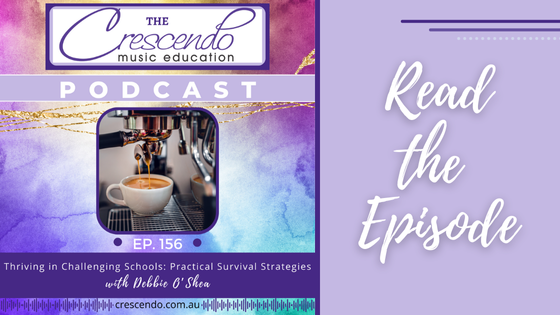
Here is the Crescendo Music Education Podcast – Episode 156.
This podcast is being recorded on the lands of the Turrbal people. I acknowledge them as the traditional owners of the land and pay my respects to elders past, present and emerging. They were the first music makers on this land.
About ‘Read the Episode’: Sometimes, we would rather skim visually than listen to a podcast! That’s a great way to learn too!
The transcript of episode 156 of The Crescendo Music Education Podcast is below.
Practical Survival Strategy 1
Debbie O’Shea
Welcome everyone. Thank you for tuning in. This is the second episode where I’m focusing on thriving in challenging schools and I’ve just got a couple of little practical strategies. You may call them survival strategies. I just want to give you a couple of tips that might help you survive and thrive in these difficult schools. It’s not easy. I don’t think anyone has all of the answers and I’m still certainly working it out as I go. What if I told you that a coffee machine could save your sanity, or that you might have the key to surviving in a tough school situation in your car boot, or in the back of a cupboard somewhere.
Okay, today I just want to talk about a few practical strategies that don’t require permission, budget approvals, or anyone’s cooperation. These are just some things that you might be able to do. Tip one is find your island, or islands, plural maybe, of civility. So this has just been a term I’ve used for, well as long as I can remember teaching, my island of civility, which was and often still is a little mini coffee plunger and a cup.
I take my own coffee and I make my own lovely plunger coffee, which is my favourite way to drink coffee and I called it my island of civility. That was just this one little moment in my school when I could be civil. Doesn’t this sound awful? But I really do think that our job is often not very civil. I’m using air quotes here, in case you’re not watching on YouTube. Like our job can be a bit grotty and ordinary. I’m teaching kids with fingers up their noses and kids that maybe haven’t had a bath recently, or they smell like maybe there’s something in their pants that shouldn’t be there at that time.
Look, our job can be like a little bit grotty. I’ll use that word because it can be. One of my favourite stories and I’ve probably said this before, tying shoelaces of particularly little boys that are wet and it’s not raining outside. And you think, no, how have these shoelaces got wet? Little things like that? You go, this is not really the same as the corporate world dressed beautifully, waltzing into lunch rooms, having long lunch meetings with wine. Our job’s different. Okay, so I think my little island of civility is often about coffee. I have discovered at one of my new schools that they have this lovely, newly renovated tuck shop and they have recently bought a coffee machine, and you can buy a coffee anytime at the tuck shop, a real coffee.
Okay, some of you are probably thinking, Oh, big deal, and you might not be a coffee drinker, or you might be at a flash school that has coffee shops for the teachers. I don’t know. All I know is, I was so excited to have this little island of civility, a little moment I could grab that coffee, sip it, walking back to the music room, if it was cool enough, because I have a long black it takes a while. It was just, I think, having this tiny little pause where I can just feel, well just be present. It’s not about the coffee. It’s about creating this moment where you can be just a little bit more you, just focus on you.
So I think my suggestion here is to find your island of civility. It could be a little quiet corner in the school somewhere you can go, or in your room just after the children have gone, there’s a little place you sit just for a moment, a mug that you take to school, that’s your favourite mug, and having a sip out of that, or a water bottle. You look at it, it’s beautifully coloured. It brings you joy, just some little island of civility that you can focus on that will help bring that little bit of joy, I guess, to your life. Protect those moments that you’ve got. They’re special. They’re for you. You might even be able to create a small ritual around them, so they’re like your reset button. So that’s my tip one, find your island of civility.
Practical Survival Strategy 2
Debbie O’Shea
The second tip is, and actually, this is for any school, difficult or otherwise, because you just never know what’s going to happen in a school. You really do not know. If you’ve been at this job for a while you know someone could vomit in the middle of your lesson, there could be a fire alarm. There could be going back a few years, there was a spate of bomb scares in schools and we would suddenly have to be out. They’ve come back from PE and they’re exhausted and what you wanted to do was so high energy but these kids are absolutely exhausted on a hot day, so we have to be flexible. You don’t know what you’re going to get. So my tip two is, always have a plan B.
Always have something in your back pocket, so have something ready for when everything falls apart. So you come in ready with tech. I’m going to start with this video clip and then I’m going to do this and I’ll hear this audio track, and you find out, actually, no, the technology’s not working, or I’m finding myself in a space I didn’t know I’d be in and there’s no technology. So always have a little bit of a backup plan, an emergency kit if you like, even if it’s in your head, doesn’t have to be physical. Most of us who’ve been around for a while have that automatically in your back pocket but bring it more to the surface ready to go.
Some simple songs you know will work. Some circle games, some interactive pair activities, physical things that they can do to be engaged. You need to create this little bit of an emergency kit, this plan B, you keep it simple. If it involves physical objects, keep it simple and portable. You could even just have it, especially if you know you’re going into a difficult school, keep literally an emergency kit. It could have some card games and some board game type activities ready to bring out and give to the children.
So use these backup activities though, so that you know how they work and that you’re really confident. And then when chaos hits and your technology doesn’t pan out, you’ve got half a lesson because they’ve come late from an excursion, whatever happens. You know how schools go. You’ve got something, you’ve got a plan B, you know it will work. You know it’s interactive. You know it’s engaging. So Tip two, always have a plan B in your back pocket.
Practical Survival Strategy 3
Debbie O’Shea
My third tip, I’ve learnt the hard way recently that you need to simplify your lessons. As was pointed out to me by my friend Deb, Hi Deb, in one of our recent conversations, sometimes especially if you’re starting from scratch in a school with no background, you have to sacrifice your pedagogical standards. Now I don’t mean, please don’t get all thingy on me. Okay, I don’t mean to drop standards so low that you will accept anything or stop trying to teach. But what you’ve got to do is move your expectations to be where the children are at and come from there.
So there’s no way, if you’re starting in a school that hasn’t had music that has some behaviour and classroom management issues big or small, you can’t walk in and do a beautifully crafted lesson with transitions and I work a little bit on their pitch element and a little bit on their rhythmic element, and that leads beautifully into a circle game. But no, that does not work when you have chaos and you’ve got children without the music background, children that say, I hate music, you can’t do a beautiful, beautiful lesson.
I think you know what I mean, especially if you’ve done some training like I have with Kodály pedagogy. You know the beautiful lesson plans with connected tone sets and transitions, you just can’t do that. I can’t do seven different things in a lesson when you’re having trouble getting them to just, I don’t know, listen to you. So here’s my tip, simplify. Go right back. Say, Okay. Now, behaviour management, classroom management is the priority. How can you teach if you don’t have the children attending in any way? So I just tried to strip it back. So after I’ve had bad days, and there’s been a few, I could actually say that potentially I’ve had some of my worst teaching days in my 43 year career.
Instead of trying to cram in more, I’ve gone right, okay, lots of self reflection. What can I do? Let’s super simplify. Let’s just do something, a bit of an introduction, bit of an engaging video clip. Maybe get them in the room, let’s do one main activity, maybe a third if there’s time. I’ve been focusing on less is more. So that to me, is having some success.
So I’m advising my third tip is to have this simplified chaos day version of every lesson, and you focus on engagement over content, because if you don’t have connection, you can’t teach curriculum. So connection before curriculum, it’s got to be some sort of connection there. So that does not mean you are giving up on curriculum. You are not giving up on teaching, you are simplifying so that you can bring the students from where they are and bring them on this journey with you in a realistic way.
Debbie O’Shea
So I will just go over my three tips for today, some practical (I hope) survival strategies. Find your island, or if you’re lucky enough, islands of civility. Two, always have a plan B in your back pocket. Three, simplify, simplify your lessons when chaos reigns. So these are not just survival strategies. They are ways to stay human and creative when everything around you feels overwhelming and when you feel personally attacked, when students are not doing what they are supposed to do, but you need to stay human.
You need to be creative. I know teachers need to feel that they are being creative when everything is overwhelming, you need some strategies to cling on to, because your well being matters. Their learning depends on your well being. I hope these strategies have helped and I hope you tune in for part three next week. Thank you so much for giving me your time everyone.
Sign-Off
Thank you for joining me for this podcast. Don’t forget, you’ll find the show notes and transcript and all sorts of information on crescendo.com.au. If you’ve enjoyed the podcast or found it valuable, you might like to rate it on your podcast player and leave a review. I’d really appreciate it if you did. All I can be as the best version of me. All you can do is be the best you. Until next time, bye.
Just for Laughs
As we know, laughter relieves stress, don’t lose sight of the funny side of life.
It’s another skeleton joke. You know why skeletons are so calm? It’s because nothing gets under their skin!
Links Mentioned in the Episode:
📜 Crescendo Music Education Podcast | Episode 156
Where to find me:
- The Stalagmite Effect: How Small, Consistent Actions Build Extraordinary Lives by Debbie O’Shea https://www.balboapress.com/en-AU/bookstore/bookdetails/865572-the-stalagmite-effect
- Crescendo Community Facebook Group: https://www.facebook.com/groups/crescendocommunity
- Official Crescendo Page: https://www.facebook.com/CrescendoMusicEd/
- YouTube: https://www.youtube.com/user/CrescendoMusicEd
- X: https://twitter.com/crescendomusic
- LinkedIn: https://www.linkedin.com/in/debbie-o-shea-62a3741b/
- Instagram: https://www.instagram.com/CrescendoDebbie/
- Pinterest: https://www.pinterest.com.au/crescendodebbie/
Subscribe To Our Blog
For the latest tips and tricks from Crescendo Music Education, fill out your details below and hit Subscribe... you will happy you did!
Dr. Rhoda Bernard’s Vision for Arts Education (Part 1) (CMEP158: Read the Episode)
Thriving in Challenging Schools: Building Relationships in Crisis (CMEP157: Read the Episode)
Leave a Comment