
Introduction
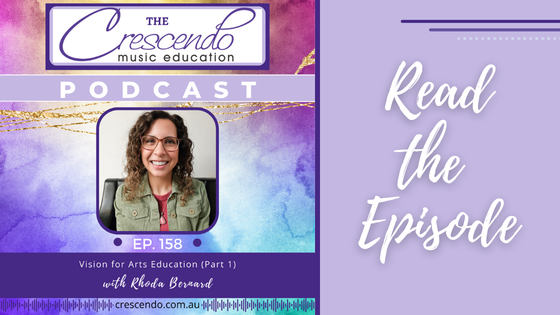
Here is the Crescendo Music Education Podcast – Episode 158.
Debbie O’Shea
Welcome to the Crescendo Music Education Podcast, I’m Debbie O’Shea and today I get to chat with Dr Rhoda Bernard. I did not know Rhoda until we had this zoom interview and I just feel she has so much to offer us and I feel we have a lot of aims in common. I know you’ll feel it too. I know you will, it’s wonderful. She is about to release her book Accessible Arts Education: Principles, Habits and Strategies to Unleash Every Student’s Creativity and Learning. I know you’re all saying, Yes, we all need a bit of that. I know you will love listening to what Dr Rhoda has to say. It’s amazing. Enjoy part one of my chat with Dr Rhoda Bernard.
This podcast is being recorded on the lands of the Turrbal people. I acknowledge them as the traditional owners of the land and pay my respects to elders past, present and emerging. They were the first music makers on this land.
About ‘Read the Episode’: Sometimes, we would rather skim visually than listen to a podcast! That’s a great way to learn too!
The transcript of episode 158 of The Crescendo Music Education Podcast is below.
Debbie O’Shea
Welcome to the Crescendo Music Education Podcast Rhoda Bernard. Hello Rhoda.
Rhoda Bernard
Hello Debbie. It’s great to be here.
Debbie O’Shea
It’s lovely to meet you. It’s a little bit odd, isn’t it, meeting virtually in your yesterday and my today, but it’s exciting. I love meeting new people with similar passion.
Rhoda Bernard
Absolutely, the personal connections are the best.
Doctor Rhoda’s Bio
Debbie O’Shea
I’m going to start off reading a brief bio. I’m sure there’s many, many more details, jump in if I say anything the wrong way. So here we go. Doctor Rhoda Bernard is the founding Managing Director of the Berklee Institute for Accessible Arts Education and the Assistant Chair of the Music Education department at Berklee College of Music. She holds a Bachelor of Arts cum laude in government from Harvard University. Good heavens in government.
Rhoda Bernard
Yeah, I went there three times. I have three degrees from that school. It’s bad.
Debbie O’Shea
Well, no, or it’s good. It’s good.
Rhoda Bernard
I got a great education. It’s just a little bit like, Could you not? I did go to New England Conservatory also, but like, Could you not, try someplace else?
Debbie O’Shea
Oh, I’m sure they did not mind keeping you. And a Bachelor of Music with academic honours in jazz voice from New England Conservatory. She earned both her Master of Education and Doctor of Education degrees from the Harvard Graduate School of Education. Bernard regularly presents keynote presentations and research at conferences throughout the US and abroad, and she provides professional development workshops for educators in local, national and international forums. Her book Accessible Arts Education: Principles, Habits and Strategies to Unleash Every Student’s Creativity and Learning will be published in September 2025.
Rhoda Bernard
I can actually say today it is now like a physical object. I don’t have it yet, but the publisher wrote to me and said, it’s a physical object now. It’s in a box on its way to you. So it’s really published.
Debbie O’Shea
That is exciting and can I say, because I know this podcast is not about me, but I’ve just published a book and when it arrived and I unboxed it and I held an actual book baby in my hand, it was so exciting.
Rhoda Bernard
I can’t wait for that moment. I’ve written lots and lots of articles and chapters in other people’s books, but I never had the time to do a book on my own and it’s been a lifelong dream. So I have a feeling I will also be over the moon when I actually have the physical object and they actually asked me to do an unboxing video.
Debbie O’Shea
Oh, you have to.
Rhoda Bernard
Yeah, so I have someone who’s going to help me so I can do an unboxing video.
Debbie O’Shea
Oh, that’s exciting. All right, okay, I’ll have to make sure I see that, because we all love a good unboxing video. All right. Her work has been published in several book chapters and in numerous journals. Bernard has been honoured with the Irene Buck Service to Arts Education award from Arts Learning (2023), the Berklee Urban Service Award (2017), the Boston Conservatory Community Service Award (2011), the Boston Conservatory Faculty Staff Spirit Award (2007) and the Outstanding Dissertation Award, Honourable Mention Second Place from the Arts and Learning Special Interest Group, oh goodness, of the American Educational Research Association. Okay, you’ve got a lot of like acknowledgement there, that is fabulous.
Rhoda Bernard
Yeah. Thank you.
Debbie O’Shea
An Active Arts Education Advocate, yes, one of us people, all of us listening. I know we’re all those. She is the immediate past chair of the Arts Education Advisory Council of Americans for the Arts and she serves on its speakers’ bureau. A vocalist and pianist who specialises in jazz music and Jewish music in Yiddish and Hebrew. She performs regularly with a number of Klezmer bands and has recorded two CDs with the band Klezamir. Okay, I got there. Alright. Now that’s that snapshot. What else do you want to say about your bio and your work history so far?
Rhoda’s Story
Rhoda Bernard
So I want to tell a story, because to really understand where I’m coming from, you need to know the story and it is what fuels all of the passion and what I’ve done for my whole career and what I intend to continue to do. So when I was a kid, I sang before I talked, a very musical child, singing, playing the piano, very active in my public school music program. Then everything changed in 1980, so in Massachusetts, a law was passed in 1979 that went into effect in 1980, this law remains on the books today. The law is called Proposition 2 1/2. What this law does.
So let me give a little bit of context. In the US, public schools are funded by property taxes, so that’s why cities and towns that have higher property taxes have better quality public schools than city and towns that have lower property tax bases. It’s one of the strange aspects of the US with the sort of tension between federal control and local control. So public schools are funded primarily locally.
There’s some federal funding, but primarily locally property taxes. So in Massachusetts when this law passed, what Proposition 2 1/2 did, among several things, was cap the annual increase in property taxes in any particular city or town, and there are 365 cities and towns in Massachusetts, at two and a half percent. So you couldn’t raise property taxes more than two and a half percent in any town from year to year.
You still can’t and the only way you can get a greater increase. So let’s say you need to build a new school building or renovate the library or some such thing, you have to pass a local referendum. They’re not easy. So when this law went into effect I was in high school. I was about to be a sophomore in high school and I was very active in the music program. I sang in all the choirs.
I was really lucky as a freshman, I was the one soprano who got to be in the show choir. I was really, really fortunate. I mean, singing was my life. Sang in all the choirs, also did a lot of theatre, very active in our drama program. For a public school we had a strong music and drama program, but it was cut the minute that law went into effect, budgets were all topsy turvy and all of the arts were cut. I went from having a great public school arts program to having nothing.
Debbie O’Shea
Okay, so when you say cut, just what does that mean? Like, you had no more teachers, you had no more like they just literally said it doesn’t exist?
After-School Singing
Rhoda Bernard
Eliminated. It ceased to exist. Okay, so this is how they responded to the budget cuts. So the woman who had been our chorus teacher and we actually had her in middle school, and then we had her for one year of high school, she called a meeting at the pizza joint across the street from the high school for everyone who had been part of chorus and there are multiple choirs.
We all sat there and had pizza, and she said, Look, by now you’ve heard my position has been cut. There is no more choral music at the high school. I’m not going to let your music education end. We are going to keep doing it and here is how, it’s going to be after school time and it can’t be on school grounds. I’m going to donate my time. You can’t pay me. I cannot accept money from you.
This is how we’re going to make sure you continue to have a music education. Let’s get together and figure out how to do it. So we did. We found a church to have rehearsals, we found a community center to hold auditions and in exchange, either they would let us use it for free, or we would perform at one of their functions as exchange. The show choir that I was fortunate to be in, my parents had a big basement. There’s a piano in the basement. We rehearsed in my house twice a week. People would bring brownies and the musicians would come, we had a little combo.
Then all of us who were singing and we would rehearse there, do all our dance moves and the whole thing. So we continued our choral music education without it being established in the school. She wouldn’t let us pay her, but Mrs. Brown, and I’m still in touch with her, and she knows that she’s had a very formative role in my life. We would mow her lawn and run errands for her, whatever we could do to support her and so that is how my music education continued. We also advocated. We performed at town meetings. We went outside of the grocery store and performed and had people sign a petition to bring the music program back, because we wanted to do something.
So that experience got me involved in arts advocacy and particularly music education advocacy, which is very important to me, and also hit home how important music is for everyone and the arts are for everyone, and how one person can make an enormous difference. So my whole professional life has been about more music and arts for more people. However I can do that and when I hear about anyone who doesn’t have those opportunities, it makes me really upset. In the US, that can be the case quite a bit, that people just don’t have access to a music education or an arts education.
Debbie O’Shea
Yeah, well, you know, you’re getting lots of internal hallelujahs over here. I’m sure everybody, if you’re listening now and you agree, come on, give me a fist pump. Yeah, I know we all say this is so needed, but that situation that you were in was quite extreme, from a thriving program to just okay, you’re gone. That’s terrible.
Rhoda Bernard
Okay? So first of all, I should say it wasn’t just my town, all over the state this was happening. Oh, and by now, they actually have a good music program. So funny story. I happen to know the person who is the choral teacher at my old high school now, it’s someone different. My former teacher, Mrs. Brown, has retired. She’s actually a competitive ballroom dancer and she’s amazing. So that’s pretty cool. But anyway, I happen to have met through really funny other circumstances, not having to do with my professional work. I happen to have met the person. She’s the girlfriend of the son of good friends, like, it’s just very strange, a small world, but she teaches there, so I’ve heard from her, and I’ve heard over the last certainly decade, if not longer, that things are back, and it’s a thriving program again.
Debbie O’Shea
Oh, that’s good. That’s sort of a bit of a happy ending, but you’ve still got the tax issues.
Rhoda Bernard
Yes.
Debbie O’Shea
So that still must be keeping a lid on things statewide by the sound?
Issues with Taxes
Rhoda Bernard
It does keep a lid on things statewide, particularly when, like I said, like a renovation of a school or some new program or initiative needs to happen, but I would say it is a struggle. So, you know, in my role as Assistant Chair of Music Education, I run the graduate programs in Music Education at Berklee and I get to know the students really well, and I also get to know the undergraduate students really well. I’ve got an alum from my program who teaches in a different community in Massachusetts that is a fairly affluent community with a strong music program.
He’s been there, I’m going to say five years, because he started during the pandemic. That sounds right. Every single year they’ve made cuts to the program and his job has had to change. Well, first it was in this school. Now they moved him to this school. First it was full time. Now it’s part time. First, he had orchestra and general music. Now he doesn’t have one or two classes, these sorts of things. There’s been a battle every single year, to the point where two years ago maybe, the teachers in his district went on strike. So these struggles are still happening.
Debbie O’Shea
We shouldn’t have to be fighting these battles as educators. Should we?
Rhoda Bernard
No, absolutely not.
Debbie O’Shea
So changes have to happen from the top, don’t they?
Rhoda Bernard
Yes, all directions.
Debbie O’Shea
Yes, yes. Oh my gosh. I agree with you so strongly, and it certainly resonates with the battles that we’re having here. And you need grassroots, absolutely grassroots. You need noise from the teachers and the parents.
Rhoda Bernard
The parents are very powerful.
Debbie O’Shea
They are more powerful than they know. As long as they know what’s going on, because sometimes they’re shielded from what’s actually happening in the schools. I know in our situation, we have to be very careful. We can’t give too much information to the families. Do you know what I’m saying?
Rhoda Bernard
I’m following you, and that’s really challenging.
Debbie O’Shea
Yeah, but we also do need to tackle it from the top. I really believe that we need to be visiting ministers and making them aware that this is happening and what can we do about it, and it’s not good for our children. Also just educating the decision makers about the importance of music education and arts education, all of the arts. But anyway, we’ll get to that at the end I think, when we talk about advocacy, because, yes, I’m so happy to have met another passionate advocate. It’s great Rhoda.
Rhoda Bernard
Same here. It’s a joy to meet you.
Debbie O’Shea
Let’s talk gratitude, because that’s just my little formula I like. I think it’s important to take time to reflect on, oh, just gratitude. Revel in the joy of what’s been great for you.
Rhoda’s Gratitude
Rhoda Bernard
Wow, I’ve been very fortunate, so the fact that the book is out, and all that it took to get there. My first ever sabbatical, I have always been in institutions that didn’t have sabbaticals. So my first ever sabbatical, and to have the space and time and real privilege to think and write. I’m tremendously grateful. So, I mean, there’s that, but I would say on the day to day. So I have two jobs at Berklee. I have the Assistant Chair of the Music Education Department and I founded and run the Institute for Accessible Arts Education.
In the latter role, I have a small but incredible team of people who work with me, all part time, all extraordinary. To the point where like our staff meetings, we meet once a week in a zoom staff meeting, because some of them are remote, some of them come in one or two days a week, that sort of thing, which is fine. Our staff meetings are just this. I sit back and watch them, each of them, talking about the great work they’re doing, and at the same time recognising the other people on the Zoom call that have been a part of it, and sharing credit and talking each other up about the great work they did together, and I feel really blessed to have such a terrific team. I’m extremely grateful for them.
I go to other meetings at Berklee and colleagues of mine are complaining about their team and I don’t say anything. I just sit there quietly because I don’t have anything to say and I don’t want to gloat, but honestly, they are the just amazing, collaborative, passionate, dedicated, uber competent, wonderful group of people. To the point where at our last staff meeting I had to say to them, because I noticed this was becoming an issue. When your hours are over, I want you to stop working. If I contact you with something that’s urgent, I’ll make sure you know that it’s urgent.
But otherwise, please don’t work too much, because they all want to so badly, but I want to be conscious of the fact that they’re all part time. When your part time jobs have a way of feeding into the rest of your life, I want them to have boundaries around their time. So I had to say to them, You’re all awesome, please have more of a life. Like, please stop when your time is done and have the rest of your life. So I feel very grateful for them.
Debbie O’Shea
That’s so wonderful. Working with a group like that just fuels you, doesn’t it?
Rhoda Bernard
It really does.
Debbie O’Shea
What a joy and the people that don’t work with groups of wonderful people. If you’re stuck in a school with a bit of a, I’ve been in schools where you walk into the staff room and the toxicity hits you and you go, Oh, this is so hard working here. Put on the brave face. Be the optimist. Go try and bring the joy in your classroom, but it’s really hard if you are surrounded by eeyores, isn’t it?
Rhoda Bernard
I agree, and I have been so I know exactly what you’re referring to, and it is so difficult. So I feel really blessed.
Debbie O’Shea
Yeah, oh, that’s wonderful. And of course, you’re grateful for that original music teacher we’ve already talked about.
Rhoda Bernard
Charlotte Brown. I’m very grateful to her.
Debbie O’Shea
Love it. Okay, let’s get into your book. I’m dying to hear about it. Okay, so the title is Accessible Arts Education. So that sounds incredibly broad, like that could be almost anything. So what’s your book actually about?
Rhoda Bernard
It’s a book to help teachers reach and teach every student they see, no matter how that person learns best. It is for teachers in any subject areas. So I, of course, come to this work with my music education background and my arts education and experience. But there are examples in the book for all subject areas, arts and non arts, music and all of the arts, like the you name it, it’s in there. All of it is applicable to everyone. But the piece of it that I think is sort of encapsulates it, is that you anticipate the barriers that someone might encounter, and then you strive to reduce or remove them, and better yet at the outset. But the world is full of all different kinds of barriers.
In a classroom setting or a private teaching setting or an ensemble setting, for example, the barriers could be in the environment. So what if the environment is very sensory stimulating, that’s a barrier for students for whom that’s a challenge, for example. Or the barrier could be in the way that you’re teaching. So as music educators, we tend to be more auditory in our teaching. Of course, we do. We are trafficking in sounds. We are making sounds. We are composing with sounds. We are perfecting the making of sounds in others.
So it’s not surprising that there’s a lot of auditory going on. But there may be some students for whom that could be a barrier that they need other modalities, right? So that’s a way that a teaching approach could be a barrier, and assessment can be a barrier. So for example, in arts education that I’ll stick to music because of our audience here, a lot of times you know it, if you can do it. So the student really knows what we’ve been working on, if it’s on the instrument.
But maybe they know it, but it’s not on the instrument yet. Maybe they can’t play it, but can they clap it. Can they sing it? Can they see somebody else do it and show them where they made a mistake? Can they teach somebody else? It might take longer for it to get in the coordination of the instrument, whatever that instrument is, but it might be something that’s already known and learned. So thinking about assessment more broadly too, breaks down barriers.
So the idea is to break down barriers so that all students have the opportunity to learn and so that what they learn is visible. We see what they’re learning, because that’s the other thing, right? There’s all this learning sometimes that’s happening that we don’t see. Of course, we are educators, learning is the coolest thing ever. We’ve all experienced it and when your students are getting it, there is no better feeling than watching someone develop and thinking you might have had even a tiny bit of a hand in helping them along in that process, that’s just the most gratifying thing. So we want that. So that’s what the book is about.
Debbie O’Shea
So yes, that is what we live for, because it’s our job. It’s why we’re doing it. So we’re looking at identifying and removing the barriers as early as possible. Sometimes I would imagine, no, I wouldn’t imagine, because I know, I live it. Sometimes the attempts to remove the barriers don’t work. So we need to go back. How else can I do that? So is this the sort of thing that you might be able to dip in into your book and go, Okay, this didn’t work. What else could I try? Because sometimes you just run out of ideas.
Alright, so I’ve got my sound sensitive little person. I’ve identified them because they’re sitting in the back of my room with their hands over their ears, and I go, Okay, why don’t we try these headphones? So we try the headphones. If that doesn’t work, what else can I try? So would your book be a resource that way perhaps?
Rhoda Bernard
In fact, definitely. In that very specific situation and lots of other situations. So the book is full of strategies, all sorts of things you can try and lots and lots of practical things in a wide range of settings that you can try. Things that you can try when you don’t even know what might be happening, or when a student hasn’t been diagnosed but you see that something’s not connecting.
So I want to answer your question with a yes and. So yes, loads and loads of strategies and things to try, very practical, easy to use hands on things and sort of a corollary to what you were talking about, which is also in the book, in the last chapter. I work with a lot of educators and we all want to transform ourselves, like you find out about something cool, like, oh, accessibility. I want to open up.
You want to wave a magic wand and transform and have done 900 things and you can’t, it’s unrealistic. So my advice to people is, try one thing, see how it goes, check it out. Try it more than once, because it might not work on one day, it might work the next day. You don’t know, try it a little bit. If that works, great. Do you feel like you’re done? You could be done. Maybe some other time you want to try another thing so you can pace this very slowly, because a lot of what we do to make things accessible, one of my mentors coined this phrase, which I use as the title of an article, good teaching on steroids.
So she said that working with students who learn in a wide variety of ways is about good teaching on steroids. So a lot of this is stuff we already know as the excellent teachers that we are, but we have to, I use this word at Berklee in our programs. We steroidify it, we stretch it out, or we slow it down, or we speed it up, or we turn it on its head, or we personalise it. So, for example good teaching, a complex task is broken down into pieces. You don’t give someone a whole new complex task. You don’t say, here’s a clarinet put it together, right?
For example, when I was learning how to drive, I was not one of those children who did go-karting. I had never been behind the wheel of a thing in my life. I had ridden a bike, but I’d never had a steering wheel and a pedal in my whole life. So I’m learning how to drive with my father in the parking lot of the shopping mall on a Sunday morning in the winter because there’s no one there. I’m sitting behind the wheel of the car and I am paralysed. It’s too much. I couldn’t say that I was 16 years old, I didn’t know what to do.
My father, who actually was a teacher, he taught religious school in his spare time, but my father said, Okay, I’ll do the steering wheel. You just do the pedals. So I just accelerated and braked while he steered the car. So we’re breaking up a complex task, right? All I have to do is one part. Then after we did that for a while, I did the steering wheel and he did the pedals, same kind of concept, and then we put it all together.
So by the end of an hour we’d spent together, I was doing it all, but I needed to work up to that. So that’s good teaching. The steroids part is that for some people, because of how they process information or how they learn best, those pieces need to be really small and the pace at which you combine those really small pieces might need to be really slow, so it might take longer to pull it all together. But if pieces are too big, we get overwhelmed, or if we try to put them together too quickly, we don’t get the skill. We don’t get the thing. So it’s matching that size of the chunk and the rate of combination to that student, and that’s the steroidifying of what we already know from good teaching. Does that make sense?
Debbie O’Shea
Yeah, that’s a great analogy. It certainly makes sense, absolutely. Also, I think looking at a class, because most of my audience, I do have instrumental teachers, but we have mainly primary classroom, elementary classroom teachers. So we have 25-30 children at a time and for half an hour, then they go, then the next lot come in.
Rhoda Bernard
So once a week, right?
Debbie O’Shea
Once a week, yes.
Rhoda Bernard
So all told you have hundreds of students.
Debbie O’Shea
Yes, yes, yeah.
Rhoda Bernard
We have the same thing in the US.
Debbie O’Shea
Most of us have about 800 children a week, that sort of ballpark. So I think that you’re talking about breaking things down into those little, small chunks. And I think that it’s essential too in that group sort of setting, because you can’t possibly understand the pace of all 30 children all the time. So you do the little bit, little bit and you also, another one of my little hobby horses I get on is you also do it in a whole lot of different ways and a lot of different contexts, and using manipulatives, doing it aurally, doing it visually. You do those little bits lots of different ways, so that the penny drops for each child at different times and at different rates. But if you keep doing it, you will get most of those kids by the end.
Rhoda Bernard
I couldn’t have said that better. I love the way you just put that. One thing that you said, I want to underscore. This is in the last chapter of the book. The last chapter is sort of the advice chapter and this is in that chapter. So teachers will come up to me and say, It’s November. So for us, our school year starts in September. They’ll say in November, I have 800 students. I don’t know how all of them learn yet, I must be failing. I’m a horrible teacher and I will say to them, give yourself a break. You will get to know your students.
You’ll get to know a few more in each class every week and you’ll get to know your students as you do. One benefit we have is we see them for multiple years. So you have time, but you are succeeding. You are not failing. It is not your job to instantly be acquainted with what’s going on inside many, many groups of 30 individuals heads all at the same time, right? So that’s exactly why all those different ways are so important.
Debbie O’Shea
Love it. I love it.
Sign-Off
Thank you for joining me for this podcast. Don’t forget, you’ll find the show notes and transcript and all sorts of information on crescendo.com.au. If you’ve enjoyed the podcast or found it valuable, you might like to rate it on your podcast player and leave a review. I’d really appreciate it if you did. All I can be as the best version of me. All you can do is be the best you. Until next time, bye.
Just for Laughs
As we know, laughter relieves stress, don’t lose sight of the funny side of life.
Why did the baker go to therapy? Because he kneaded it!
Links Mentioned in the Episode:
📜 Crescendo Music Education Podcast | Episode 158
Where to find me:
- The Stalagmite Effect: How Small, Consistent Actions Build Extraordinary Lives by Debbie O’Shea https://www.balboapress.com/en-AU/bookstore/bookdetails/865572-the-stalagmite-effect
- Crescendo Community Facebook Group: https://www.facebook.com/groups/crescendocommunity
- Official Crescendo Page: https://www.facebook.com/CrescendoMusicEd/
- YouTube: https://www.youtube.com/user/CrescendoMusicEd
- X: https://twitter.com/crescendomusic
- LinkedIn: https://www.linkedin.com/in/debbie-o-shea-62a3741b/
- Instagram: https://www.instagram.com/CrescendoDebbie/
- Pinterest: https://www.pinterest.com.au/crescendodebbie/
Subscribe To Our Blog
For the latest tips and tricks from Crescendo Music Education, fill out your details below and hit Subscribe... you will happy you did!
Dr. Rhoda Bernard’s Vision for Arts Education (Part 1) (CMEP158: Read the Episode)
Thriving in Challenging Schools: Building Relationships in Crisis (CMEP157: Read the Episode)
Leave a Comment