
Introduction
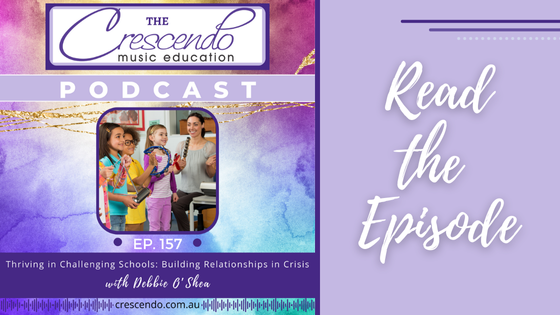
Here is the Crescendo Music Education Podcast – Episode 157.
This podcast is being recorded on the lands of the Turrbal people. I acknowledge them as the traditional owners of the land and pay my respects to elders past, present and emerging. They were the first music makers on this land.
About ‘Read the Episode’: Sometimes, we would rather skim visually than listen to a podcast! That’s a great way to learn too!
The transcript of episode 157 of The Crescendo Music Education Podcast is below.
Debbie O’Shea
Debbie O’Shea here and thank you so much for joining me for Episode Three in our Thriving in Challenging Schools podcast series, just another short one for you and it’s probably the most important. It’s all about building relationships. Teaching is all about building relationships. But when you are in crisis, because it can seem that extreme, when you are teaching in schools that are difficult, and certainly the students you’re dealing with are probably in crisis. That is why they are being difficult. Relationships are what matters Absolutely. My first day in a difficult school, I recall walking through the school and a little girl unknown to me just walked up to me and said, Oh, you’re beautiful.
Those of you who’ve seen me, yeah, you know that it would be difficult to apply those words to me. I am an older lady, but I am wearing tie dye and I do have pink hair. And to a lot of little people, I am beautiful. They love the colours. So I immediately have a relationship with that little person now, like, that’s the sort of thing you grab, any little thing that happens and that will help form your relationships. Now, how do you form those relationships with students that push every boundary, like every boundary, and I know some of you know what I’m talking about. Fact, if you’ve been at this job for a while, you’ve been in a few different schools, you know what I am talking about, everything from I’m not coming into the room for defiance reasons.
I’m not doing that activity, I’m not singing, I’m not playing, and worse. But let’s talk about how we could slowly turn the troublemakers. I’m going to speak in generalisations, because we have to really. Not troublemakers, let’s turn them into allies. So how do we do this? How do we form relationships when the students are very determined that they do not want a relationship and we need to know there’s some sort of relationship there for education to work. They don’t have to be your best friend. I’m not talking about that. I’m talking about a student, teacher relationship that works on mutual respect.
Relationship Building: Tip 1
Debbie O’Shea
So here’s my first tip, some strategic inclusion. So try and get those troublemakers to help. So the students that I have the biggest challenges with, I try to give a role just small at various times as appropriate, to help them and me succeed. I need them to help me. Can they help you bring something from the car? Before school, you need help with carrying something. Choose the students wisely that you might go, Okay, this is good. One, I would like to get to know them a little better. Two, they have helped me. They quite like doing things like that out of school time generally. Yes, I’ll help you carry the drums. I’ll do this. For them unwittingly, unknowingly, you are forming a relationship with them.
You are helping to give them this little bit of ownership and I’m giving them a little bit of responsibility. I’m showing them respect and I am just hoping that they will slowly give me respect back, and I’m allowing them to demonstrate some behaviour that’s really positive and really useful, and you can play on that with younger classes. It may be as simple as I remember a long time ago, there was one little person and I actually gave them the job of turning the lights off when we had a video, don’t bother now, we’ve got such good technology, you don’t need the lights off. But then we needed the lights off to see the video clearly.
That little person, it turned them around because they had a job. I’d say, Oh, we’re watching a video now and they would jump up so happily and turn the lights off. So I gave them responsibility and they took it and ran with it, and felt useful, and it gave them a sense of self. And you know what? It helped me. So that’s my first tip, strategic inclusion, ask them to help you. So I would advise you to identify your challenging students as early as possible.
That’s not hard is it, find meaningful ways to include them as helpers. It’s easier done with the younger kids than the older ones, but you will find something for them to help with. The older ones can help set something up for you, something like that. Give them ownership over something important during the lesson and make it feel like it’s a privilege, not a punishment obviously. No, you’re going to clean up for me, or you’re going to set up because you’ve been terrible. No, we want them to feel like you are helping, you are worthy. Quite a few of these students are from trauma, troubled backgrounds, they possibly do not feel valued and worthy very often. So why don’t we do that? It just might help. Even if you turn one child around, it is worth doing. So that’s tip one, get the help, strategic inclusion.
Relationship Building: Tip 2
Debbie O’Shea
Tip two, and I touched on this a bit in the last episode. Meet the kids where they are, not where you want them to be. So you’ve got to accept the current reality. You can’t just go, I’m aiming up here, I am a good, experienced teacher and I should be able to do this. Yeah. Well, guess what? Get over yourself Princess and I’m talking to myself you realise. Because starting at a difficult school with a lot of experience under your belt, you expect to be able to do it quite easily and then you are shocked when you can’t, again talking to myself.
So accept where they are at. So if you demand, they suddenly become perfect students. Well, guess what? You’re going to be really disappointed. So look at where they’re at and adjust your expectations. So if you can’t get them to pay attention, just while you give some instructions before they do an activity, well, if they won’t listen at all, okay, I’m going to see if I can get them for two minutes. I will keep my instructions really short and then I will allow them to go and do this activity and give them that little bit more freedom, because they’re used to having complete freedom or not listening at all.
Sorry, that was all a bit of a rave, but you know what I’m trying to say, Accept where they’re at and move them just a little bit further towards where you need them to be. So you’ve got to assess their starting point quite honestly. What are their social skills? What are their music skills? What’s their attention span? What is their behaviour like? What’s their behaviour like in the classroom, in the other subjects, other specialists, if they have that. So where am I starting? Then what am I going to expect from them? So that’s the first thing to do. The second thing is to design your expectations to just stretch them a little bit towards where you want them to go, not too much, because that will break them.
You’ll get nothing, you’ll get worse than it started. So just a little bit more. Just expect a bit more and you gradually build those skills, because there is no way you are getting instant transformation. If your reality is children talking back at you, yelling in your face, then you’ve got to start there. This is my reality. How am I going to do this? I will keep my voice low. I will give them respect. I will hope I get some in return and I’ll just have my expectations a little bit higher than where they’re at now. So meet kids where they are. Oh, look, I know I’m stating the obvious. As educators, you know that’s what you’ve got to do, but you’ve got to remind yourself, I think sometimes, that you need to set your expectations appropriately.
Relationship Building: Tip 3
Debbie O’Shea
Tip three, give responsibility to gain respect. I think you’ve got to turn the whole equation upside down. You’ve got to respect first, then expect it back. I find that quite difficult when somebody is being really disrespectful to you. It is human nature to not want to be respectful back, but that is what you really have to do. I feel when you’re in these situations, you just keep showing them respect. I’m the adult. I have no real understanding of where these students are coming from, what they’ve been through, I’m going to treat them with respect.
If we’re doing a music making activity, a drumming circle, something, other kids get to be the leader as well. I don’t want to be the only one in charge. I want to give them real responsibility, real leadership opportunities and then something will shift. And I’m not talking about major responsibility and leadership, just real responsibility and leadership within the music room context and that’s quite possible. We’re lucky. We can do that in music.
So look for moments to hand over control appropriately. I would say moments. I wouldn’t say to hold the scale there. We just for moments acknowledge their expertise. I found a couple of great movers. Oh, my goodness, they can move better than I’ve ever been able to move. Acknowledge their expertise when you see it, certainly even acknowledge any efforts. Thank them for that and respect their challenges. Even if you can’t fix it, you’ve got to respect it. So please be respectful to them no matter what, that modeling is so powerful and give them responsibility as you can.
Debbie O’Shea
So in closing, these kids in difficult schools, they want to connect. They need to connect actually, they’re just protecting themselves from more disappointment. Are you going to be just another grown up that you know treats them like they know. If you just keep showing up, you keep believing them, you keep taking these little steps. Give yourself little goals, then perhaps you believing in them might be the thing that changes everything. So my tip one, strategically include the students. Tip two, meet the students where they’re at, not where you want them to be. And three is give that responsibility to gain respect and give respect yourself. Remember you may be just exactly what these children need right now.
Sign-Off
Thank you for joining me for this podcast. Don’t forget, you’ll find the show notes and transcript and all sorts of information on crescendo.com.au. If you’ve enjoyed the podcast or found it valuable, you might like to rate it on your podcast player and leave a review. I’d really appreciate it if you did. All I can be as the best version of me. All you can do is be the best you. Until next time, bye.
Just for Laughs
As we know, laughter relieves stress, don’t lose sight of the funny side of life.
What do you get when you cross a snowman and a dog? Frostbite!
Links Mentioned in the Episode:
📜 Crescendo Music Education Podcast | Episode 157
Where to find me:
- The Stalagmite Effect: How Small, Consistent Actions Build Extraordinary Lives by Debbie O’Shea https://www.balboapress.com/en-AU/bookstore/bookdetails/865572-the-stalagmite-effect
- Crescendo Community Facebook Group: https://www.facebook.com/groups/crescendocommunity
- Official Crescendo Page: https://www.facebook.com/CrescendoMusicEd/
- YouTube: https://www.youtube.com/user/CrescendoMusicEd
- X: https://twitter.com/crescendomusic
- LinkedIn: https://www.linkedin.com/in/debbie-o-shea-62a3741b/
- Instagram: https://www.instagram.com/CrescendoDebbie/
- Pinterest: https://www.pinterest.com.au/crescendodebbie/
2 responses to “Thriving in Challenging Schools: Building Relationships in Crisis (CMEP157: Read the Episode)”
-
That’s really great advice Debbie. Thanks for sharing! 🙂
-
Thanks Steve. Living my own advice!
-


Subscribe To Our Blog
For the latest tips and tricks from Crescendo Music Education, fill out your details below and hit Subscribe... you will happy you did!
Dr. Rhoda Bernard’s Vision for Arts Education (Part 1) (CMEP158: Read the Episode)
Thriving in Challenging Schools: Building Relationships in Crisis (CMEP157: Read the Episode)
Leave a Comment